
Professor of Computer Science · University of New Mexico

Lydia E.
TapiaRobotics, artificial intelligence & computational methods

I am a computer scientist, educator, and research leader working at the intersection of intelligent motion, machine learning, and complex systems.

Professor · Director of the Tapia Lab · Former Chair of Computer Science

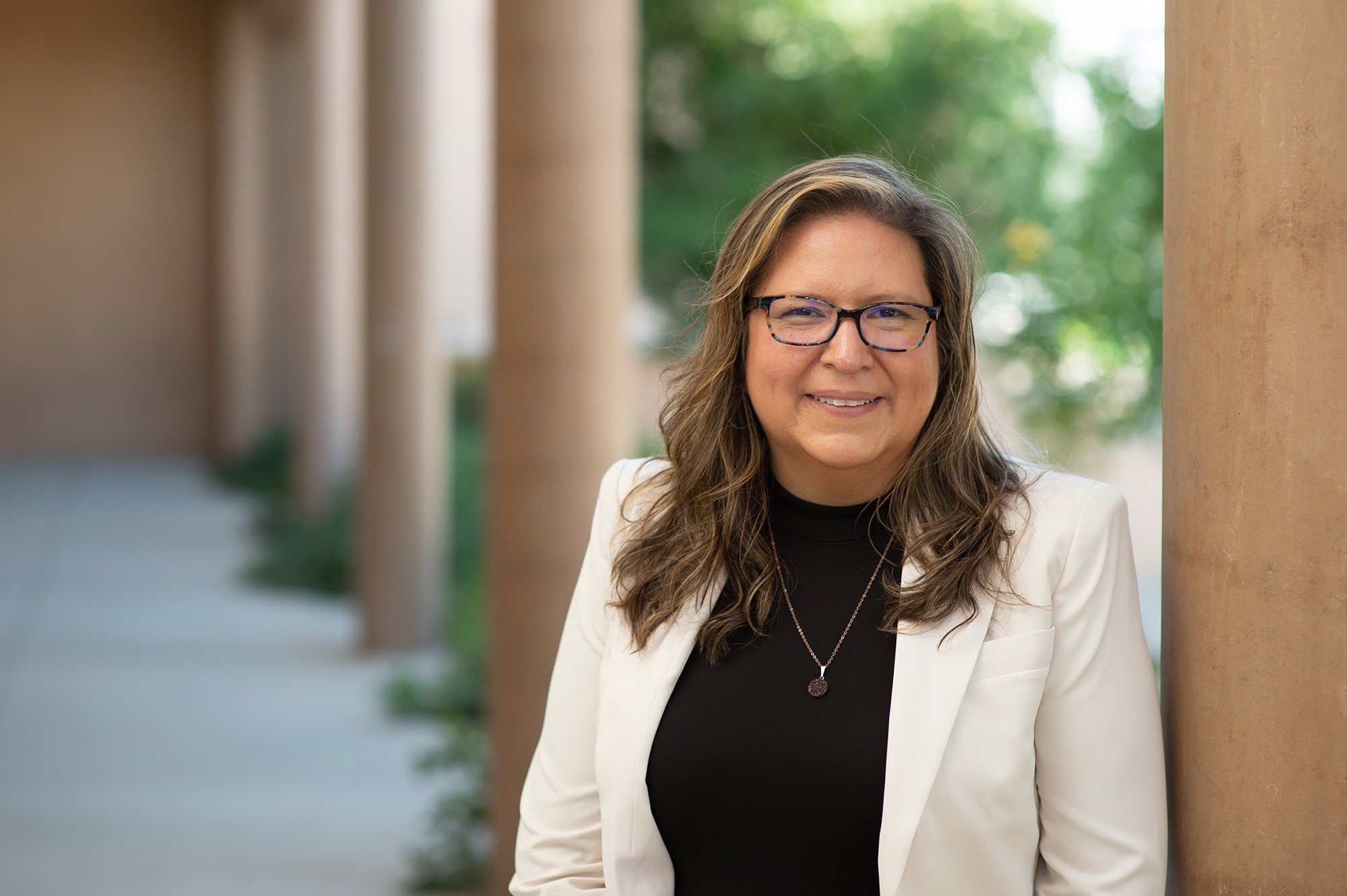
Lydia Tapia standing beside a column on the University of New Mexico campus
Professor of Computer Science
Albuquerque, New Mexico
At UNM

Research,
teaching,
leadership.

My work develops computationally efficient approaches for planning and decision making in high-dimensional or uncertain systems. I also teach artificial intelligence and reinforcement learning, mentor researchers across career stages, and contribute to national computing organizations.

Detailed projects, publications by research area, software, models, lab members, and outreach activities live on the Tapia Lab website. This page serves as my primary UNM faculty profile and a record of selected professional milestones.

Department of Computer ScienceProfessor · University of New Mexico
Tapia LabDirector · Robotics and artificial intelligence
Association for Computing MachineryMember-at-Large · 2026–2030
Computing Research AssociationBoard of Directors · 2023–2029
Selected highlights

Moments that
matter to me.

Grace Hopper Celebration · 2015 & 2018

It’s a marathon,
not a sprint.

At the 2018 Grace Hopper Celebration, I spoke with Hai Ah Nam about sustaining research, work, and life through graduate school and beyond. The Grace Hopper community also recognized my research and broadening-participation work with the 2015 Denice Denton Emerging Leader ABIE Award.
Professional leadership

Serving computing research at a national scale.

Elected to ACM Council as a Member-at-Large for 2026–2030 and to the Computing Research Association Board through 2029.

UNM leadership · 2022–2025

Building capacity in Computer Science.

As department chair, I led six-year ABET reaccreditation, completed approved faculty growth across key computing areas, strengthened student advising and support, and advanced major national searches and external engagement.

Department of Computer ScienceUniversity of New Mexico
Mentoring

From a first research experience to a research career.

I have mentored researchers from high school through postdoctoral training, with former advisees continuing into faculty, research, and doctoral positions. I extend that commitment nationally developing programs that support students, new faculty, and department chairs across the computing community.

Across career stagesPeople & alumni
Teaching

Learning by
building and testing.

My courses connect foundational ideas to systems students can implement, evaluate, and explain. Research advising extends that process from forming a question through communicating a result.

01

Artificial
Intelligence

Search, knowledge representation, planning, probabilistic reasoning, and learning, with project-based evaluation of intelligent systems.

02

Machine
Learning

Supervised and unsupervised learning, neural networks, optimization, generalization, and rigorous empirical evaluation of learned models.

03

Deep Reinforcement
Learning

Markov decision processes, value-based and policy-gradient methods, actor–critic algorithms, exploration, and reproducible experimentation.

Mountain landscape beneath a blue New Mexico sky
Research at Tapia Lab

The research has its own home.

The Tapia Lab site contains the detailed research areas, projects, publications, people, code, models, workshops, and outreach. My work there spans motion planning and robot learning, human–AI teaming, safe and adaptive autonomy, and computational biology.

My trajectory

A career crossing
boundaries.

1998
Foundation

B.S. in Computer Science, Tulane University.

The undergraduate thesis examined the role of universities in expanding participation by women in engineering and computer science.

2004–05
Early technical contribution

Machine learning enters the motion-planning loop.

Co-authored an early framework using learned problem characterization to match regions of configuration space with suitable roadmap-based planners.

2009–11
Research formation

Ph.D. research connects intelligent planning and high-dimensional motion.

Completed a Ph.D. at Texas A&M, followed by a Computing Innovation Postdoctoral Fellowship at UT Austin studying protein folding.

2011
University of New Mexico

Joined UNM and established the Tapia Lab.

Built an independent research and mentoring program spanning robotics, artificial intelligence, and computational biology.

2015–17
Recognition & research scale

ABIE, NSF CAREER, and Borg Early Career recognition.

National recognition brought together contributions to high-dimensional motion, computational biology, mentorship, and broadening participation.

2018
Planning + learning

PRM-RL receives the ICRA Best Paper Award in Service Robotics.

The work combined learned local navigation policies with sampling-based roadmaps for long-range tasks. The year also included service as a Google Faculty in Residence and WAFR co-chair.

2022–25
Institutional leadership

Professor and Chair of UNM Computer Science.

Led accreditation, faculty growth, student-support improvements, academic planning, national searches, and external engagement.

2023–26
Research community

CRA Board and National Academies service.

Contributed to national computing-research governance and to the consensus study setting a research agenda for machine learning in safety-critical applications.

2026–30
Professional leadership

Elected ACM Member-at-Large and re-elected to the CRA Board.

Leadership connecting research, graduate education, mentoring, and responsible governance across the computing community.

Selected distinctions

Research,
leadership, impact.

Recognition spanning technical contributions, research leadership, mentorship, and work to broaden participation in computing and robotics.

2023

Women in Technology Award

New Mexico Technology Council

2021

Women in STEM Award

University of New Mexico

2019

Distinguished Former Student

Texas A&M Computer Science and Engineering

2018

Best Paper in Service Robotics

IEEE International Conference on Robotics and Automation

2017

Borg Early Career Award

Computing Research Association

2016

NSF CAREER Award

National Science Foundation

2015

Denice Denton Emerging Leader ABIE Award

Anita Borg Institute · Grace Hopper Celebration

2009

Ph.D. in Computer Science

Texas A&M University

Contact & office

Find me
at UNM.

Office

Farris Engineering Center
Room 3400 B

Mailing address
MSC01 1100
1 University of New Mexico
Albuquerque, NM 87131-0001
Department

Department of Computer Science
University of New Mexico