
Build
Code, learned policies, model data, training data, and printable research demonstrations.
Tapia Lab shares robotics and AI research through open code, trained models, educational materials, technical workshops, mentoring programs, and demonstrations for schools and communities.
Our work spans motion planning, machine learning, human–AI interaction, and computational biology. We also release the artifacts that make research reusable, build technical communities around emerging problems, and create pathways into research.
Code, learned policies, model data, training data, and printable research demonstrations.
Technical workshops connecting robotics, machine learning, planning, control, and computational biology.
Mentoring programs, broadening-participation efforts, and demonstrations for schools and community groups.
Selected Tapia Lab releases span computational biology, human–AI interaction, and robot motion planning. Current projects, foundational software, archival research artifacts, and hands-on teaching materials are identified separately so visitors know what each resource provides.
This computational-biology release documents the construction of three-dimensional molecular models, Monte Carlo simulations, rule-based modeling, and analysis used to study how IgE occupancy and antigen valency shape aggregate formation.
A mobile navigation game and supporting research infrastructure for studying how people use, adapt to, and coordinate with autonomous navigation controllers over repeated interactions.
AMPE brings together planning algorithms and simulation environments developed to study robot navigation among stochastic and dynamically moving obstacles.
Network code and training data for predicting the space occupied by robot motions across multiple geometries and resolutions. The release reproduces the original experiments and uses the software environment current at publication.
Three-dimensional models of an adenosine receptor, adenosine, and caffeine make competitive receptor binding tangible for classroom and community demonstrations.
Archived releases may require legacy dependencies. Consult the repository documentation before reuse.
Short demonstrations make the underlying research problems visible—from interception and crowded navigation to learned geometry and molecular modeling. Use the controls to explore selected videos from the Tapia Lab channel.
A deep-reinforcement-learning study of how robot representations affect interception performance and robustness.
Watch on YouTubeTapia Lab has organized and co-sponsored workshops at major robotics and computational-biology meetings. Some developed technical communities around emerging research; others paired research exposure with mentoring and career development.
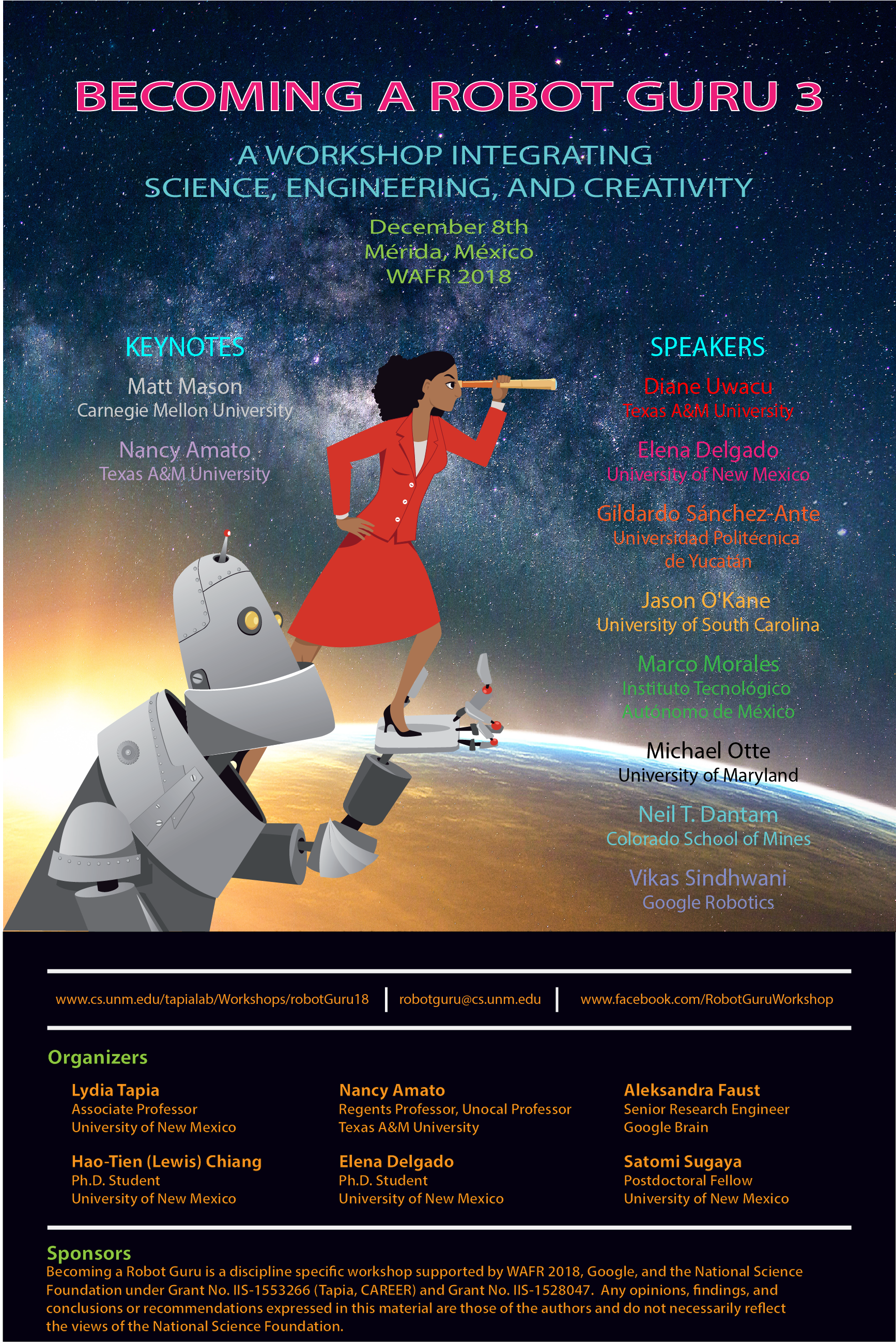
A full-day robotics and mentoring workshop connecting undergraduate participants with graduate, faculty, and industry mentors.
Forums for researchers to compare methods, define open problems, and form collaborations across technical boundaries.
Programs connecting students with graduate, faculty, and industry mentors while making research careers more legible and accessible.
Robotics & mentoring · WAFR
Technical workshop · ICRA
Interdisciplinary careers · ACM BCB
Broadening participation · RSS
Technical workshop · IROS
Broadening participation · ICRA
Technical workshop · IROS
Interdisciplinary research · RSS
Our outreach includes studying and documenting how conference leadership, research labs, robotics start-ups, and mentoring programs can create more effective pathways into robotics and computing.
Tapia Lab welcomes requests for robot demonstrations from schools and community organizations. In your message, please include the audience, approximate group size, location, and possible dates so we can determine what is feasible with current lab schedules and equipment.
